Situated high on a hill top overlooking the Bay of Ocho Rios, Shaw Park features 25 acres of tropical gardens, with a waterfall, natural pool, and an abundance of tropical trees, plants and flowers.
An eco-tourism attraction set within 130 acres of tropical forest, with 40 acres of landscaped gardens, and dozens of tropical plants, flowers and birds. There is a hiking trail along the Little River that leads to its source. Other activities for visitors include bird watching and fishing.
HopeGardens, or the RoyalBotanical Gardens, Hope, were formerly part of major Richard Hope's Estate. One of the English officers who helped capture Jamaica from the Spanish in 1655, Hope was granted a huge parcel of land as a reward. At one time Hope Estate extended from the sea to the hills in Newcastle. In the 17th and 18th centuries Hope was a sugar estate one of the first where water (from the HopeRiver) was used to turn estate mills. The Hope Aqueduct (which can still be seen at HopeGardens, MonaHeights and Mona Road) was built for that purpose. In 1766 Richard Elletson Hope arranged for Kingston to be supplied withwater from his estate, but after his death, his wife remarried a British Duke and cancelled the water concession. Kingston lost its water supply. In the 1840s the duke's son sold the city of Kingston 234 acres of the estate bordering on the HopeRiver. Kingston's water was eventually drawn from this land as part of a publicly owned system.
The 200 acres of Hope Estate land that eventually became HopeGardens (and one of Jamaica's few public parks) in the late 1870s-early 1880s includes a Palm Avenue where sago palms are among the oldest living trees, a cacti garden, a bougainvillea walk, a maze, a forest and lily pond. Other attractions include a zoo, a lake, a fountain, military band concerts and even a poet's corner. There is also what remains of CoconutPark. When Queen Elizabeth II came to Jamaica in 1953, the gardens were officially renamed the Royal Botanical Gardens. The Gardens have been undergoing repairs since 1996.
These gardens, along with Fern Gully in St. Ann and Holland Bamboo Grove in St. Elizabeth, are maintained by the Ministry of Agriculture's Public Gardens Division (927-1257). They are used regularly in photo shoots and to provide educational programmes designed to expose students to general gardening practice. Crop management and botanical information can be obtained on request and some plants are also available for commercial sale
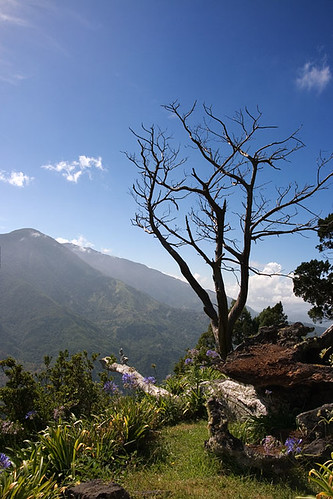
St. Andrew's Cinchona Gardens, located on 7 hectares of a 10-acre property more than 5,000 ft above sea level, were established in 1868. Named after the Cinchona plant brought to Jamaica from Peru by the Spanish, these gardens offer spectacular views of the Blue Mountain Ridge and parts of Kingston. Quinine, an extract of this plant, was used to treat malaria. The Spanish learned about this medicinal property by observing the Peruvian Indians and the plant came to be known as Jesuit's Bark before being renamed for the Countess of Cinchona, the wife of the Spanish viceroy of Peru, who benefited from treatment. When Cinchona was first planted, it fetched a high price on the world market and a good return on the funds invested realized. However, due to poor roads, a lack of general transport in the area and labour costs, this project could not compete competitively on the world market. It eventually failed in 1899. A second section of the land was planted out in tea but Jamaica never could compete with tea from India. A third section, which is all that remains, was known as a 'European Garden' with the cinchona tree, mulberry, camphor, cork oak, juniper and rubber trees as well as garden flowers that thrive in northern climates.
Castleton Gardens in St. Mary lies on 10 hectares of land through which the Wag Water River runs. Located on both sides of the Junction main road, at one time these gardens boasted the best collection of plants on the island, including over 400 specimens from Kew Gardens. The Poinciana (1869) and Bombay mango (1869) tree were first planted at Castleton, as were the navel orange and tangerine (1870).
The Bath Botanical Gardens was the second botanical gardens to be developed in the western hemisphere (the oldest is on St. Vincent). Located in St. Thomas, this 1-hectare property was specifically put aside when the town of Bath was laid out. It was under the care of Dr. Thomas Clarke, a botanist who was also in charge of the Bath hospital. The garden was stocked with Chinese and Japanese herbs and exotic fruit trees, including the breadfruit, ackee and Otaheite apple brought by Capt. Bligh. The croton, jacaranda and bougainvillea were also fist planted at Bath. Frequent flooding in the 19th century by the Sulphur River wreaked havoc on the gardens and that along with the realization that the soil was not as nutrient rich as had been hoped caused its relocation to Castleton in 1862. Bath Gardens is still maintained for its historical value.
credited from jamaica-gleaner.com flickr user elizabean




 credited from fiwiroots.com

 credited from jamaica-gleaner.com

