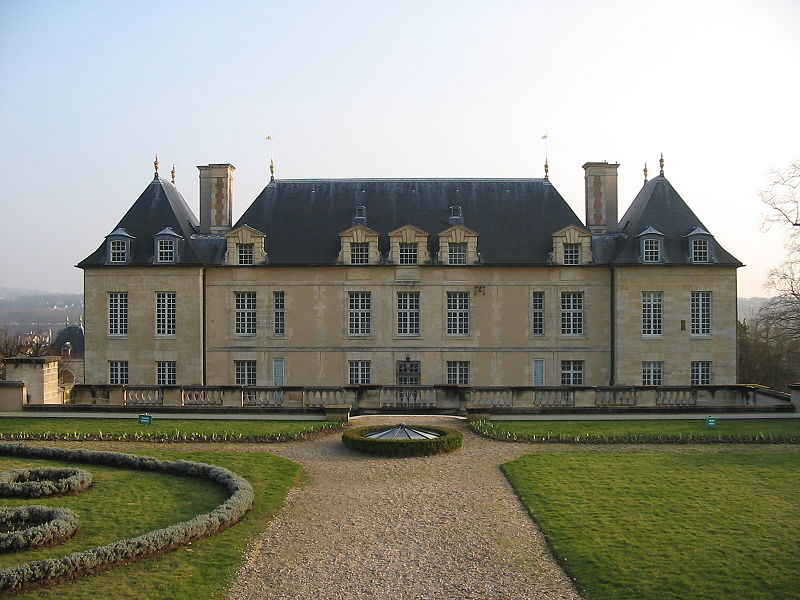
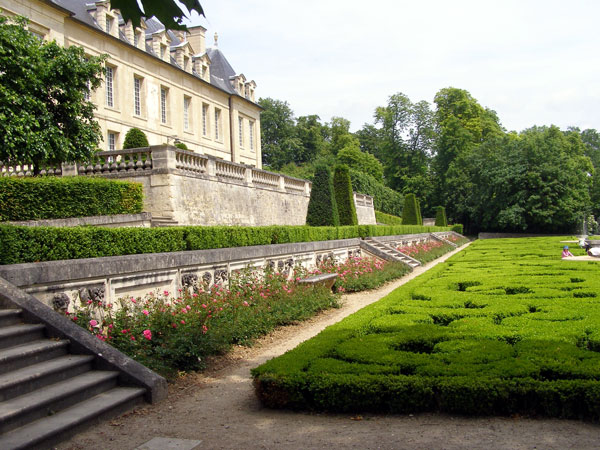
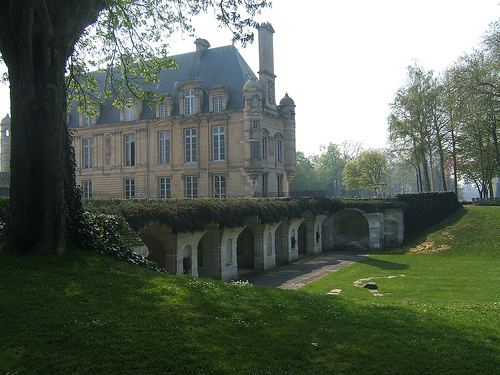
A seventeenth century chateau with a 50 hectare park and gardens, restored in the late 1980s and early 90s, with excellent views over the Oise valley. There are terraces, parterres, a gazebo and orangerie. Each year, an artist is commissioned to produce a work for the north terrace.
The royal Château at Amboise is a château located in Amboise, in the Indre-et-Loire département of the LoireValley in France.
Built on a promontory overlooking the LoireRiver to control a strategic ford that was replaced in the Middle Ages by a bridge, the château began its life in the eleventh century, when the notorious Fulk Nerra, Count of Anjou, rebuilt the stronghold in stone. Expanded and improved over time, in the mid 1400s, it was seized (4 September 1434) by Charles VII, after its owner, Louis d'Amboise, was convicted of plotting against Louis XI and executed in 1431. Once in royal hands, the château became a favourite of French kings; Charles VIII decided to rebuild it extensively, beginning in 1492 at first in the French late Gothic Flamboyant style and then after 1495 employing two Italian mason-builders, Domenico da Cortona and Fra Giocondo, who provided at Amboise some of the first Renaissance decorative motifs seen in French architecture. The names of three French builders are preserved in the documents: Colin Biart, Guillaume Senault and Louis Armangeart.
Amboise was the site where a garden laid out somewhat in the Italian manner was first seen in France: the site of the origin of the French formal garden. At the time of Charles VIII, an Italian priest, Pasello da Mercogliano, is credited with laying it out. Charles widened the upper terrace, to hold a larger parterre, enclosed with latticework and pavilions; round it Louis XII built a gallery, which can be seen in the 1576 engraving by Jacques Androuet du Cerceau, in Les plus excellens bastimens de France. The parterres have been recreated in the twentieth century as rectangles of lawns set in gravel and a formal bosquet of trees.
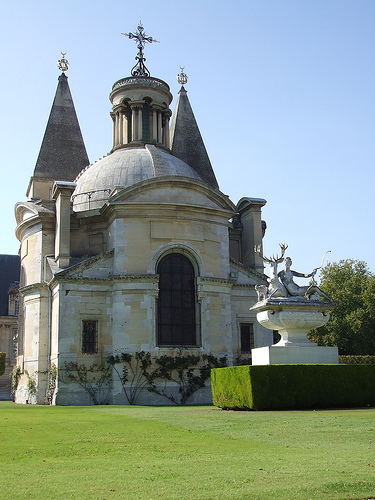
King François I was raised at Amboise, which belonged to his mother, Louise of Savoy, and during the first few years of his reign the château reached the pinnacle of its glory. As a guest of the King, Leonardo da Vinci came to Château Amboise in December 1515 and lived and worked in the nearby Clos Lucé, connected to the château by an underground passage. Tourists are told that he is buried in the Chapel of Saint-Hubert, adjoining the Château, which had been built in 1491–96.
Henry II and his wife, Catherine de' Medici, raised their children in Château Amboise along with Mary Stuart, the child Queen of Scotland who had been promised in marriage to the future French Francis II.
In 1560, during the Wars of Religion, a conspiracy by members of the Huguenot House of Bourbon against the House of Guise that virtually rules France in the name of the young Francis II was uncovered by the comte de Guise and stifled by a series of hangings, which took a month to carry out. By the time it was finished, 1200 Protestants were gibbetted, strung from the town walls, hung from the iron hooks that held pennants and tapestries on festive occasions and from the very balcony of the Logis du Roy. The Court soon had to leave the town because of the smell of corpses.
At Amboise the abortive peace of Amboise was signed, 12 March 1563, between Louis I de Bourbon, Prince de Condé, who had been implicated in the conspiracy to abduct the king, and Catherine de' Medici. The "edict of pacification", as it was termed, authorised Protestant services only in chapels of seigneurs and justices, with the stipulation that such services be held outside the walls of towns. Neither side was satisfied by this compromise, nor was it widely honored.
Amboise in decline
Amboise never returned to royal favor. At the beginning of the 17th century, the huge château was all but abandoned when the property passed into the hands of Gaston d'Orleans, the brother of the Bourbon King Louis XIII. After his death it returned to the Crown and was turned into a prison during the Fronde, and under Louis XIV of France it held disgraced minister Nicolas Fouquet and the duc de Lauzun. Louis XV made a gift of it to his minister the duc de Choiseul. During the French Revolution, the greater part of the château was demolished, a great deal more destruction was done, and an engineering assessment commissioned by Emperor Napoléon Bonaparte in the early 1800s resulted in a great deal of the château having to be demolished.
King Louis-Philippe began restoring it during his reign but with his abdication in 1848, the château was confiscated by the government and became for a while the home in exile to Emir Abd Al-Qadir (1848–53). In 1873, Louis-Philippe’s heirs were given control of the property and a major effort to repair it was made. However, during the invasion by the Nazis in 1940 the château was damaged further.
Since 1840, the Château d'Amboise has been listed as a monument historique by the French Ministry of Culture. Today, the present comte de Paris, descendant of Louis-Philippe, repairs and maintains the château through the Fondation Saint-Louis.
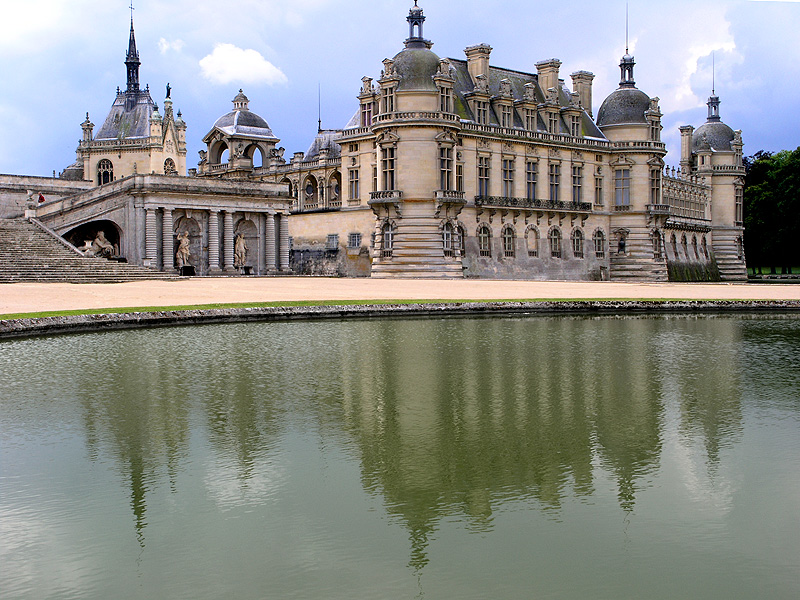
Few gardens make such spectacular use of tranquil water as Chantilly. A castle was built on a rock in a marshy forest, with the lake serving as a moat. A renaissance garden was made (c 1550) and transformed into the present high baroque garden by Andre le Notre in 1663. Water, aggrandised by design, remains the dramatic and all-pervasive element. The chateau is moated. There are fountains, cascades, a water parterre and basins. The River Nonette becomes a garden canal during its passage through the site. There are ponds in the jardin Anglais, designed by Victor Dubois c1817. Chantilly has been prominent in the history of France, though the present chateau was designed in 1875. Anne duc de Montmorency was born here in 1493; it was the Grand Conde who commissioned le Notre; General Joffre, hating the sight of blood, had his headquaters here during the First World War. Like clockwork, Joffre would lunch at noon, walk in Chantilly's woods, issue orders, perhaps for a general advance on the western front, dine at 7 pm and retire to bed leaving instructions not to be disturbed on any account. The gardens have elan and something of the war memorial about them.
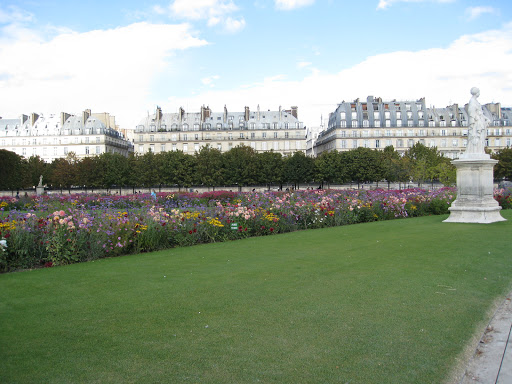
Jardin du Carrousel is the official name for the space around the Arc de Triomphe du Carrousel, built to celebrate Napoleon's victory at Austerlitz (a carrousel is a horse parade). Jacques Wirtz was landscape architect for the space around the arch. It looks entirely appropriate on plan but is less successful on the ground. Strips of stone paving radiate from the triumphal arch. Westward, they meet grass and become clumpy hedges. The best feature of the scheme is the 18 statues by Aristide Maillol (1861-1944) placed between the hedges; the problem with the paving is that the surrounding gravel makes it always chalk-smeared; the problem with the hedges is their poor maintenance and relative lack of dignity.
The farm of Bois Richeux, situated in the heart of the Carnutes' Forest, is one of the oldest farms in France, dating back to Celtic times. In 1178, it became the Villa Franche of the Chapter of Chartres and hosted the first free farmers.
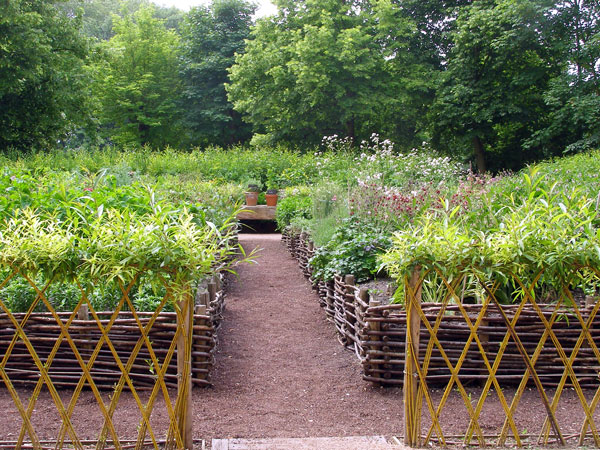
Throughout the entire Middle Ages, it was an important fortified farm, with manor, chapel, tithebarn (XIIth century) and dovecote (1364). In 1674, the property was purchased by Madame de Maintenon and Louis XIV. The Medieval Gardens of Bois Richeux reflect this very special history. All around the manor, aromatic, culinary and medicinal plants are laid out in a checkerboard pattern. A secluded courtyard, protected from the Beauce winds by a fine trelliswork of climbing vines and osier, contains the kitchen garden and courtly flowers. The hornbeam cloister, leading from the "Room of love" to the "Room of meditation" is a reminder that the Bois Richeux Gardens are not merely a collection of plants but also a spiritual journey into the symbolism of the Middle Ages.
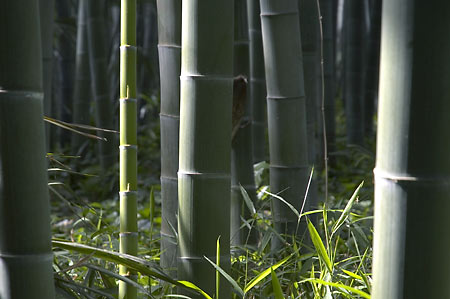
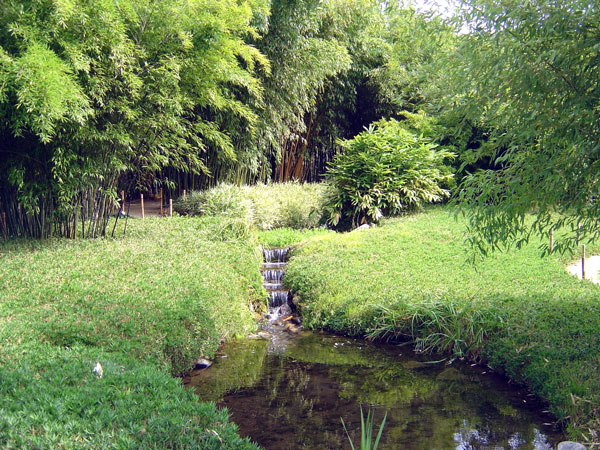
The Bamboo Plantation is here not only to let you discover, learn about and appreciate just bamboo, but all vegetal life. Run by a management that thinks that a botanical garden is not just a collection of rare plants, the Bambouseraie brings together people, facilitates exchanges, crossing cultures and linking knowledge. In this spirit, the Bambouseraie welcomes artists whose works are often inspired by vegetation. Since 1977, many sculptors, painters and Land Art artists have exhibited their works along the paths and in the clearings of the Bamboo Plantation.
- Size: the park has a surface area of 12 hectares. - 4th largest arboretum in France: the park has approximately 200 varieties of bamboo and many spectacular trees (The Bambouseraie is classed as a European Conservatory for its collection of Phyllostachys - bamboo, by the CCVS (Conservatory of Specialized Vegetal Collections). - The most visited Garden in France (with Villandry): 360,000 visitors per year, of which 20% come from abroad. - Most visited natural site in the Gard.
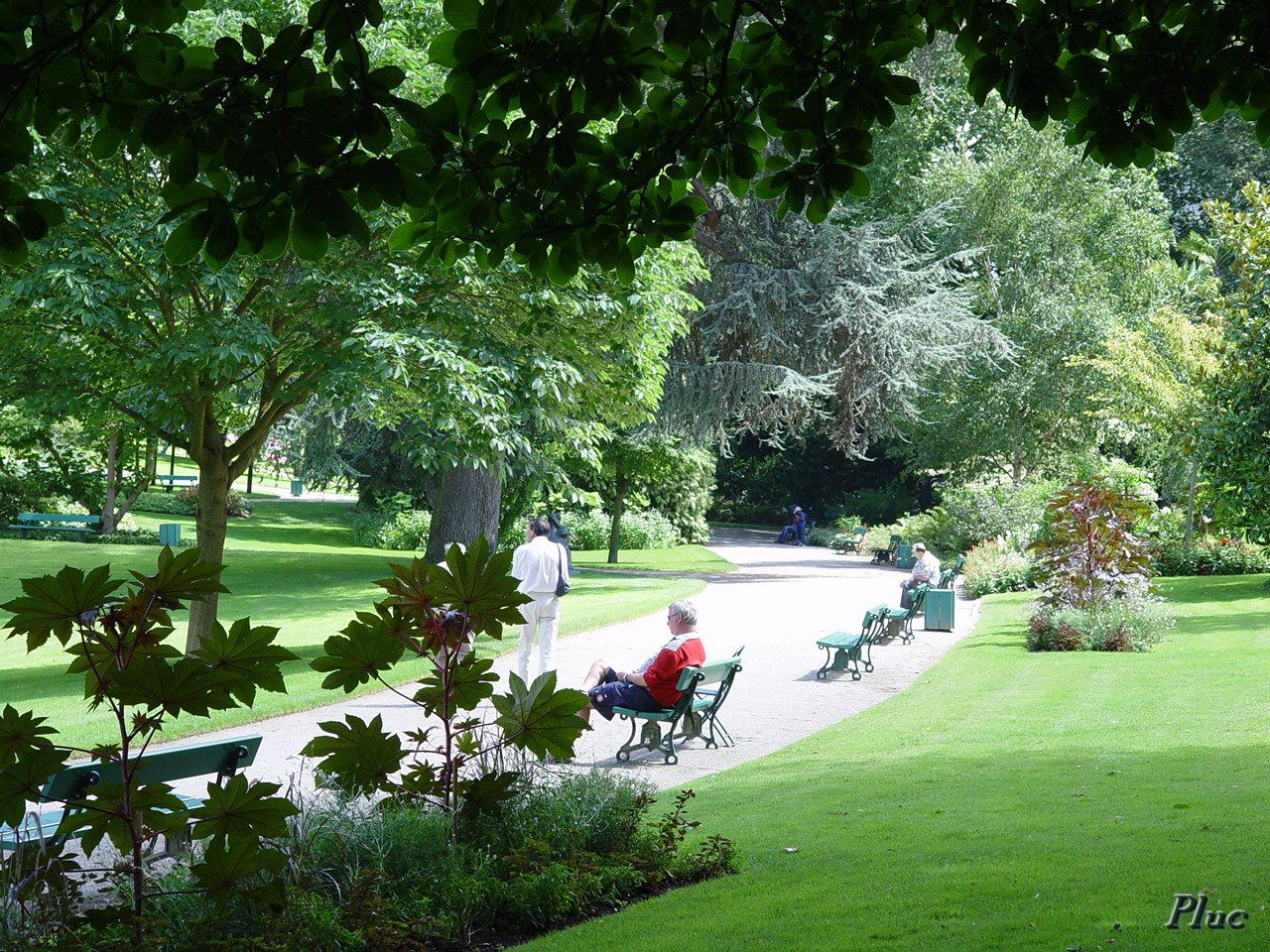
Opened as a botanical garden in 1798, the Angers Jardins des Plantes became a public park in 1898, designed by Edouard Andre. The sweeping lines of the paths, the well-placed statues and the gardenesque planting are characteristic of his style. Le Jardins des Plantes in Angers a ouvert 1798 comme jardin botanique. C'est devenu un parc public en 1898, conu par Edouard Andre. Les lignes courbantes des chemins, des statues bien-places et de la plantation de gardenesque sont caractristiques du modle d'Andree. from gardenvisit.com
Little remains of the once-famous renaissace and baroque gardens. It was one of the earliest renaissance gardens in France with an axial relationship between the house the garden. This was replaced by an example of what is known as the Anglo-Chinese style. The chateau was designed in the mid-sixteenth century by Philibert de l'Orme for Diane de Poitiers. The chateau survives and there is a drawing of the famed renaissance garden
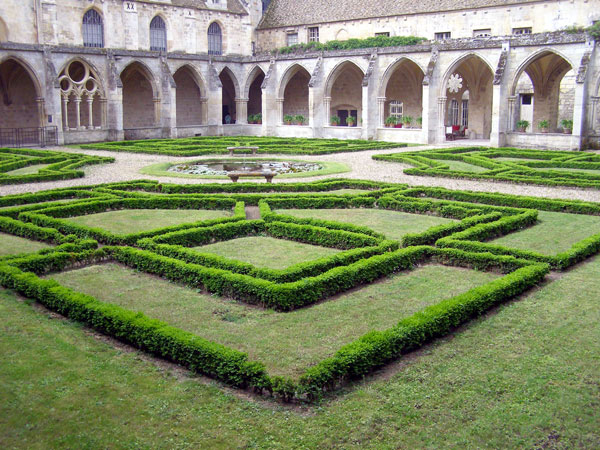
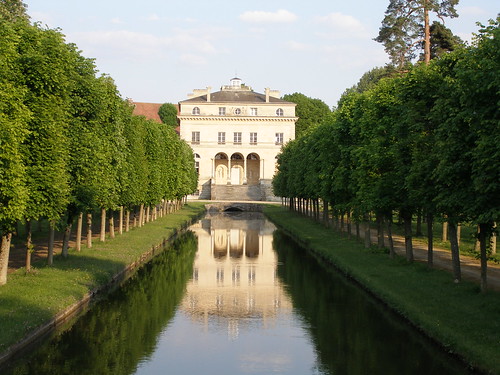
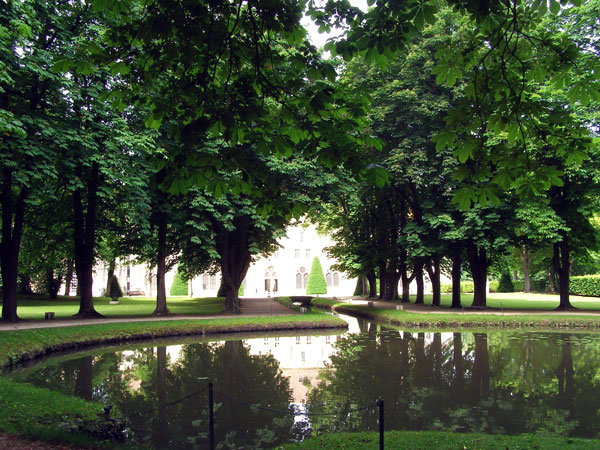
The largest Cistercian abbey of Ile-de-France was built between 1228 and 1235. It became a cotton mill after the French Revolution, a hospital during the First World War and an international cultural centre after the Second World War. The grounds were also restored. A park was made in the nineteenth century park and a re-created medieval garden was designed by Olivier Damée in 2004, south of the abbey. The marker on the location map below points to the medieval garden - if you zoom in you can see the nine squares that make up the garden. The park has canals and avenues planted with chestnut trees.
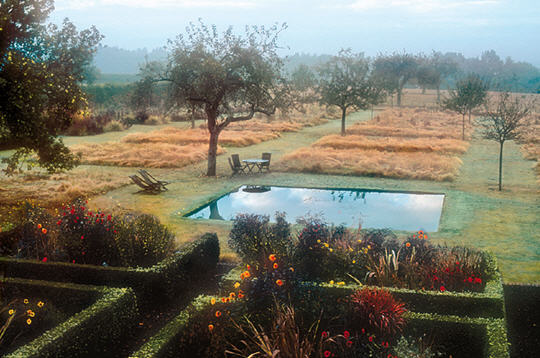
The summer garden is a kind of modern knot garden with a very formal layout of clipped box in a square edged pattern. Each 'box' is then filled with a very natural planting of grasses and perennials but the colours are superb. Lots of golden yellow, deep red, burning oranges... The overall mix of formal and informal, the somber green of the box and the jewel colours of the flowers is really superb. Favourite plants here are dahlias, crocosmias, heleniums, kniphofias and of course grasses - giving the plumes the garden is named for.
Because of the strong structural element to the garden and the use of plants which remain interesting in the winter the garden is still beatiful in the winter.
Masses of euphorbias and hellebores and many other plants mean that spring is wonderfully fresh and verdant in the jardin plume .
Autumn is my favourite. All the grasses and cimifugias make the backdrop to the asters and helianthus etc a bit like a firework display. Magic.
Added to all this there is a fabulous garden centre where you can buy most of the plants grown in the garden.


















 credited from french-gardens.com